Totality over Burgos.
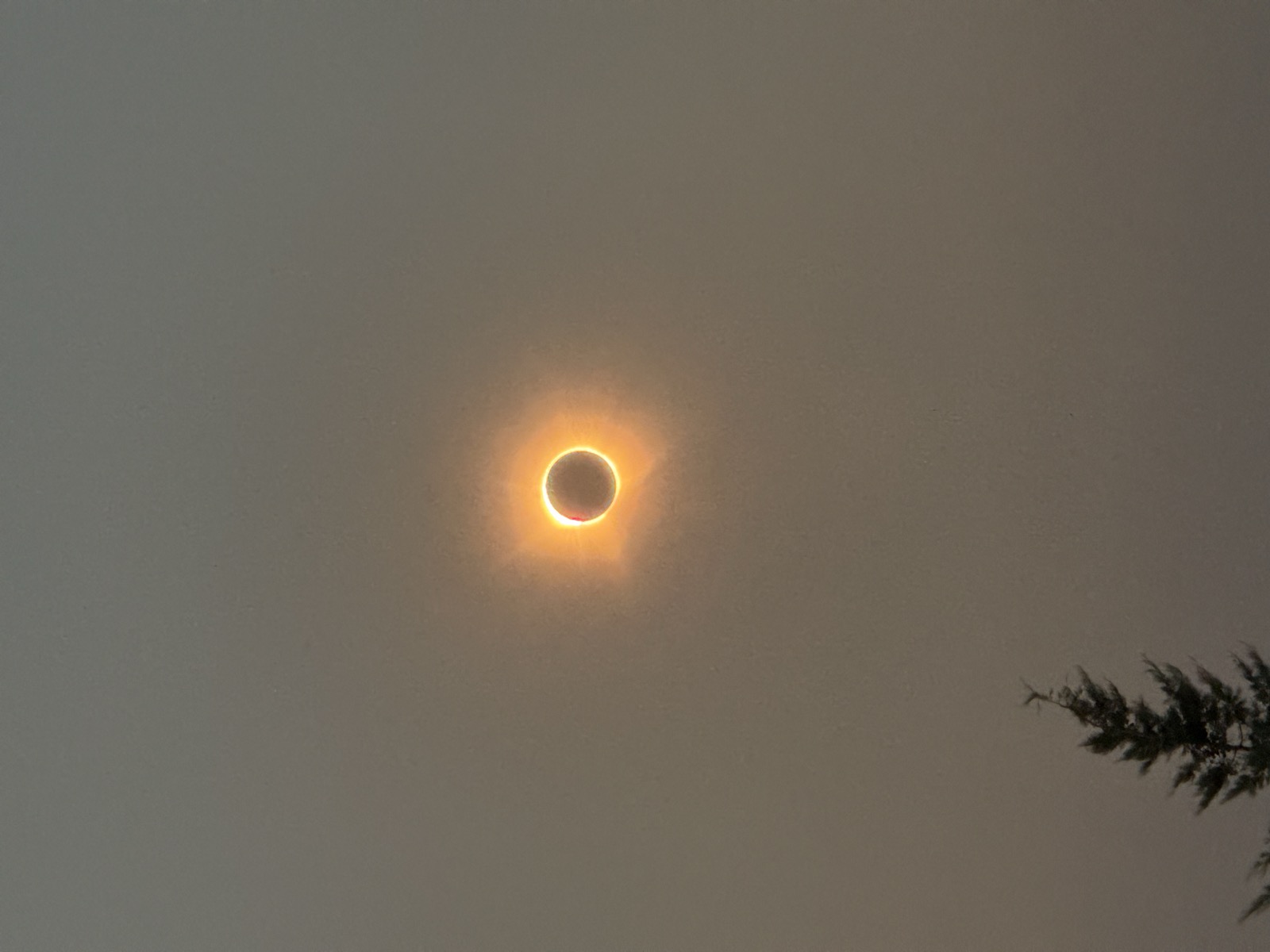
For 1 minute and 47 seconds the Moon covered the Sun completely, eight degrees above a smoke-hazed Spanish horizon. Eighteen frames from a hillside at 948 m, plus the geometry behind them, fitted to the contact times, and a light curve read straight out of the camera's EXIF data.
1 m 47 s
Totality
8°
Sun altitude at max
948 m
Observing altitude
1.008
Eclipse magnitude
One evening, scrubbed.
Drag the playhead, or use the arrow keys, to move through the eclipse from first contact at 19:33 to sunset at 21:20. The photo, the model's obscuration figure and the Sun's computed position all follow the same clock, and every frame is re-centred on the Sun: the handheld framing wandered, so the stage stabilises it. Frames 11–13 sit inside the 107-second totality window; frame 14 lands three seconds before third contact.
19:40:25
PartialLocal time (CEST) · frame 1 / 18
- Obscuration (model)
- 0.9 %
- Sun altitude
- 15.9°
- Sun azimuth
- 276° WNW
- Shutter · ISO
- 1/40 s · ISO 1250
- Focal length (equiv.)
- 200 mm
Obscuration and Sun position are computed live from the model in section 02, not looked up.
Two circles, three timestamps.
Drag the Moon. The whole page follows
- Separation d
- 2.04 Rs
- Obscuration
- 0 %
- Magnitude
- 0.00
Modelled obscuration over the evening
Everything on this page runs on a small model with a single physical input: the apparent size of the Moon relative to the Sun, k = 1.04. Near maximum, the centre-to-centre separation of the two disks follows a hyperbola in time: a straight-line fly-by seen in projection. Grab the Moon and drag it along its track: the timeline, the photos and the curve below all follow, because they share one clock. The formula being dragged:
The three published contact times pin it down completely. Totality is symmetric about the closest approach, so t0 is the midpoint of C2 and C3; first contact means d = 1 + k and second contact d = k − 1 (in units of the solar radius). Subtracting the two conditions:
With d in hand, the covered fraction of the Sun's disk is the classic two-circle intersection ("lens") area:
Fitted values for Burgos: v ≈ 6.05×10⁻⁴ Rs/s, dmin ≈ 0.024 Rs, peak magnitude ≈ 1.008. The Sun's altitude and azimuth in the readout come from the standard NOAA solar-position algorithm plus atmospheric refraction, which matters at eight degrees. The constant-velocity fly-by is a local linearisation; it is excellent over this ±1 hour window, not a general ephemeris.
The camera as photometer.
Every frame's EXIF block records what the auto-exposure decided: shutter time t and ISO at a fixed f/2.8. That is a measurement. Converting each frame to an exposure value,
gives a light curve of the evening as the camera metered it. Read it carefully: the deepest points are not inside totality. Five minutes before second contact (frame 10) the meter needed half a second of exposure, and right after third contact (frames 15–16) it bottomed out at −0.7 EV. The totality frames jump up instead, because the spot meter is sitting on the brilliant corona, and frame 14 at 670 mm reads brightest of all. The curve measures what the camera pointed at, not just how dark the evening got. It tells both stories at once.
Tap a point to jump the timeline to that frame
Third contact, up close.
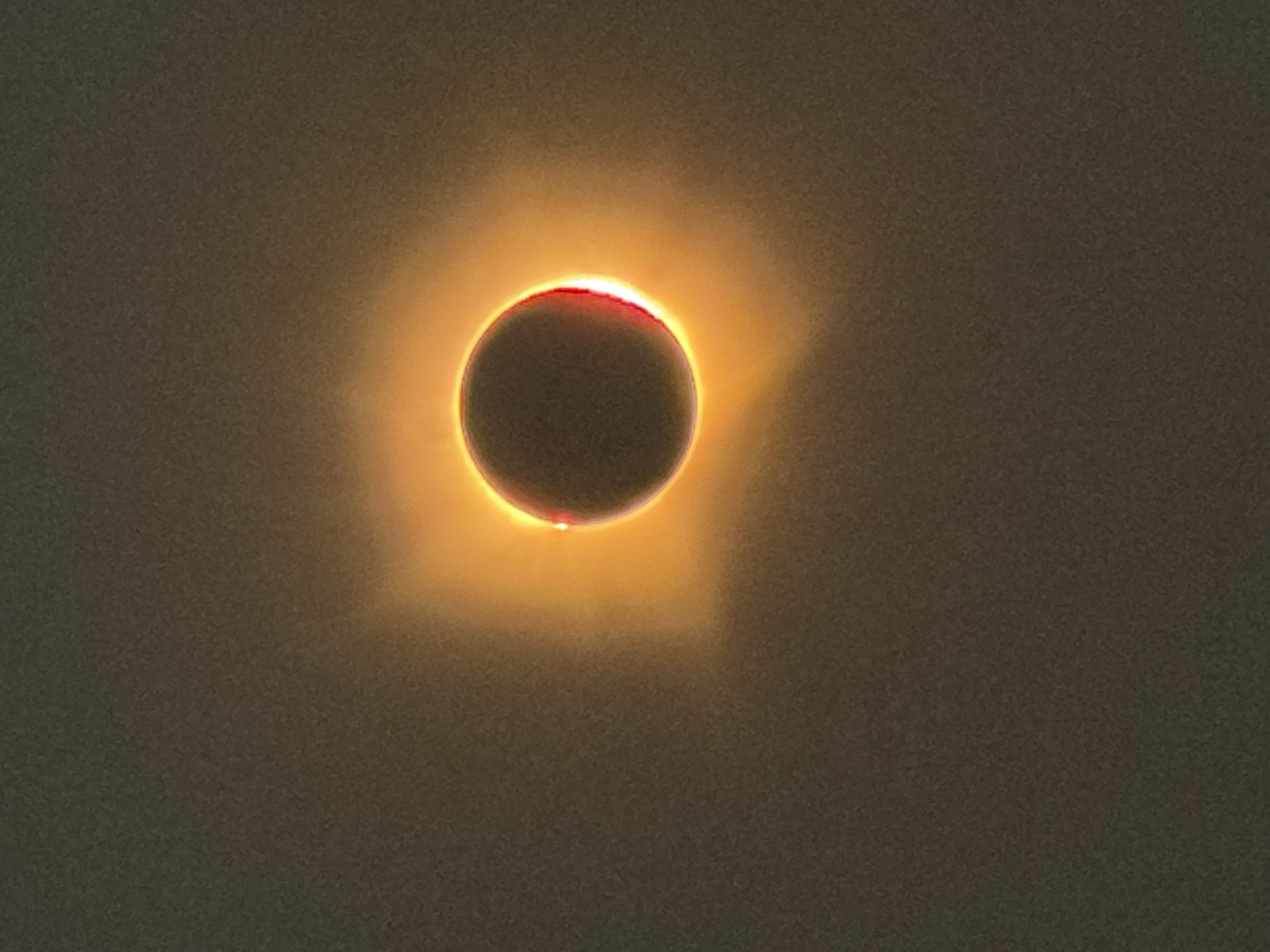
Frame 14, taken at 20:30:06 local, three seconds before third contact, shot at 670 mm equivalent. Along the limb where the photosphere is about to reappear, the chromosphere shows as a thin red arc, with prominences, loops of plasma suspended in the Sun's magnetic field, standing beyond it. The red is hydrogen-alpha emission at 656 nm: for these few seconds the Moon blocks the million-times-brighter photosphere and the Sun's atmosphere becomes visible to a phone camera.
Move the loupe over the lower-left limb to inspect it. Everything you see there spans a few thousand kilometres; Earth would fit comfortably inside one of those loops.
Totality, in motion.
Every still on this page is an Apple Live Photo, and this is the 2.6-second companion clip of frame 12: mid-totality, sound and all. It is the closest thing to standing on that hillside: the corona hanging still in a sky the colour of slate, and everyone around you talking in whispers.
Compressed from the original HEVC to a 0.5 MB H.264 clip, small enough to ship on a static page.
The place, from the pictures.
Everything in the header of this page was read out of the photos themselves. The EXIF blocks put the camera at 42.3491° N, 3.7061° W at 948 m, on a hillside on the northern edge of Burgos, Castilla y León, and timestamp all eighteen frames to the second, which is how they line up so neatly with the published contact times.
The deep orange of the partial phases is honest too: at maximum the Sun stood only 8° above the horizon, so its light crossed roughly seven times more atmosphere than it would overhead, through a sky already loaded with smoke from the August 2026 wildfires. The same low Sun meant the show never finished: the still-partially-eclipsed Sun set at 21:20, before fourth contact could happen.
Local circumstances · Burgos
- First contact (C1)
- 19:33 CEST
- Second contact (C2)
- 20:28:22 CEST
- Maximum
- 20:29:15 CEST
- Third contact (C3)
- 20:30:09 CEST
- Sunset (eclipse in progress)
- 21:20 CEST
- Totality duration
- 1 min 47 s
- Camera
- iPhone 17 Pro