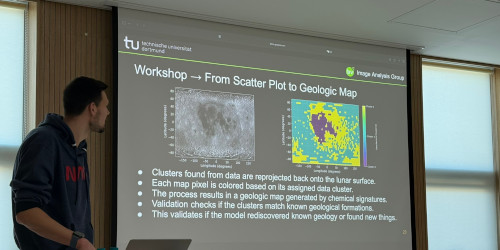
Preparing and holding a workshop for foundation models in planetary science at the KI-GAM project meeting in Daejeon, South Korea. The workshop focused on the application of mulitmodal foundation models for planetary science, covering topics such as data fusion techniques, model interpretability, and future research directions for KRGS data use.
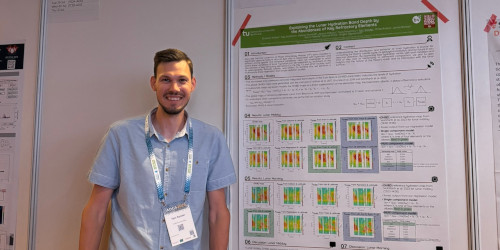
Presented a poster on reconstructing lunar hydration maps using a variational approach with linear additive compositional maps to demonstrate the most influential factors on the lunar hydration cycle.
During the summer of 2025, I attended the European Lunar Symposium (ELS) in Münster, Germany. This conference brought together researchers from across Europe to discuss the latest developments in lunar science and exploration.
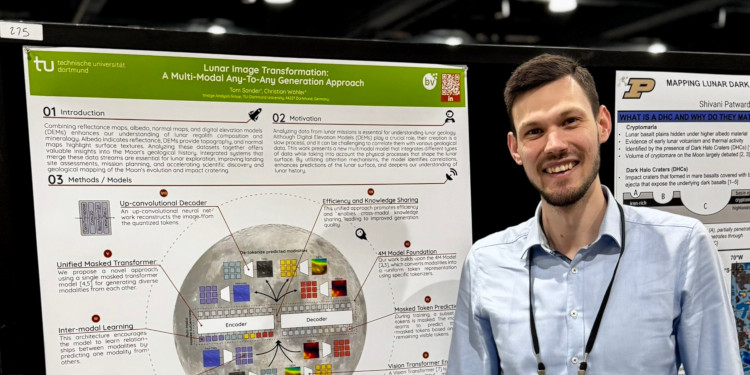
I presented my research on multimodal lunar reconstruction using foundation models. The trip was an excellent opportunity to connect with international researchers in planetary science. Discussing the physical plausibility of our generated digital elevation models with domain experts provided valuable insights for future iterations of the project.
On this trip, I presented my work for anomaly detection in planetary datasets. The conference was a great platform to share our findings and receive feedback from the computer vision community.
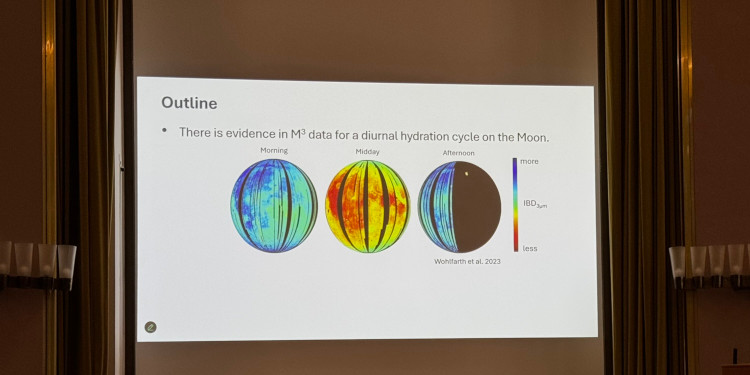
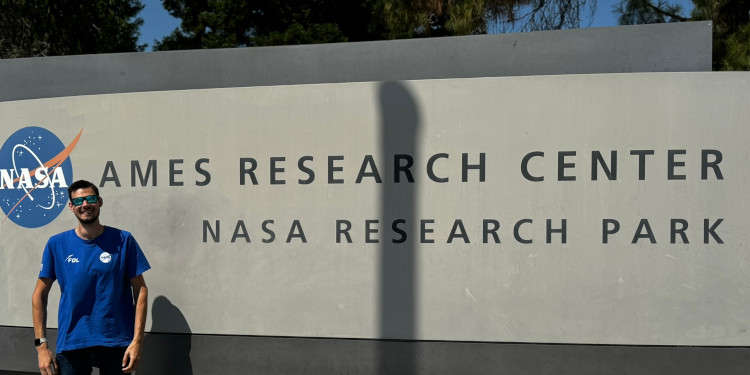
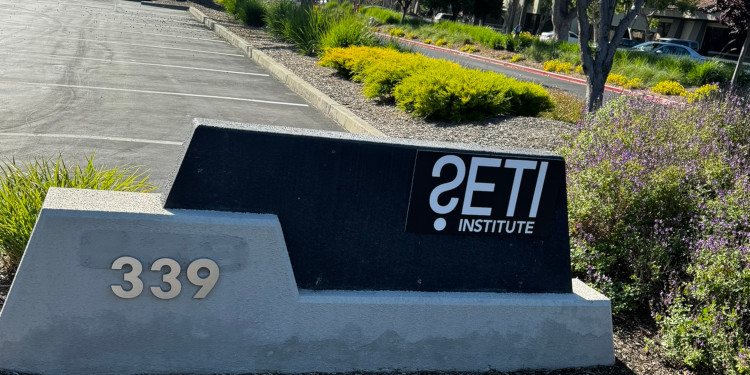
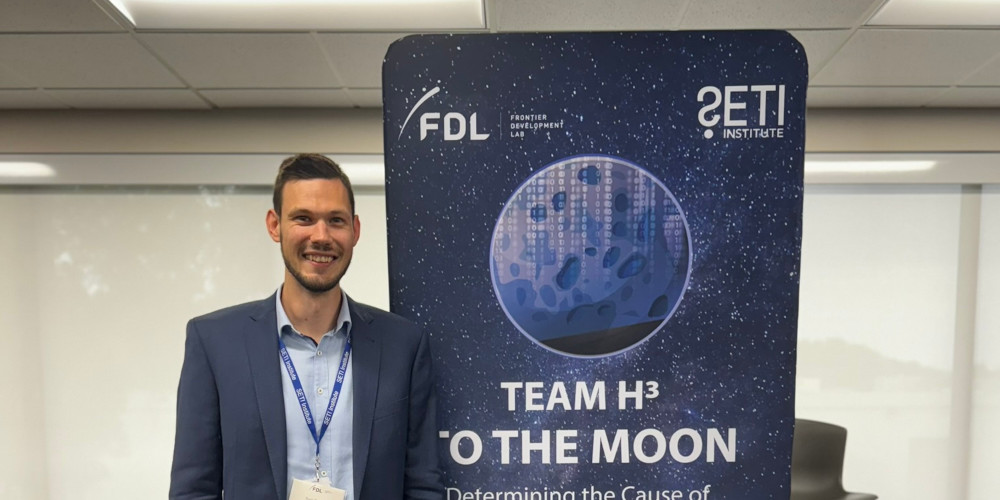
During the summer, I attended the Frontier Development Lab (FDL) program at the SETI Institute in Mountain View, California. This intensive research program focused on applying AI and machine learning to complex space science challenges. Our team worked on developing a machine learning approach to identify correlations in the lunar hydration cycle.
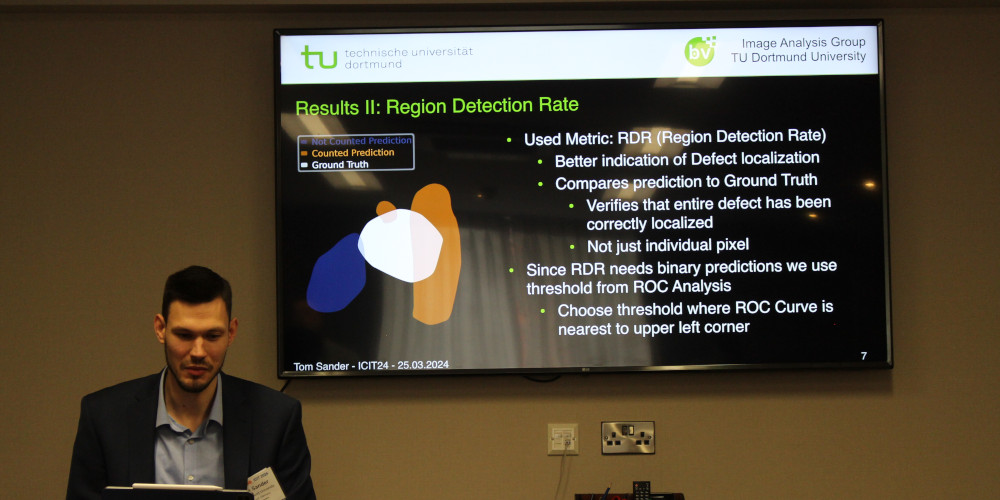
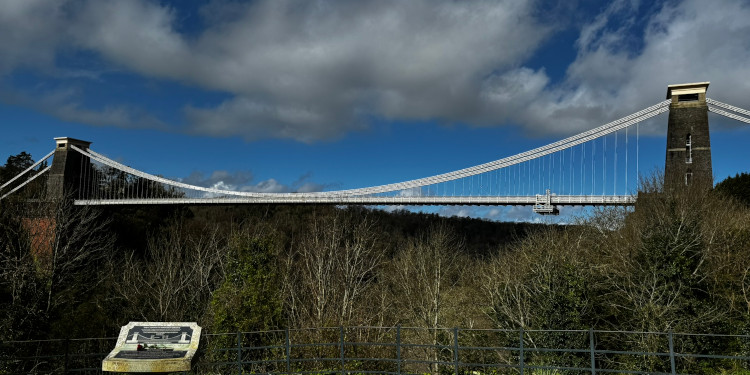
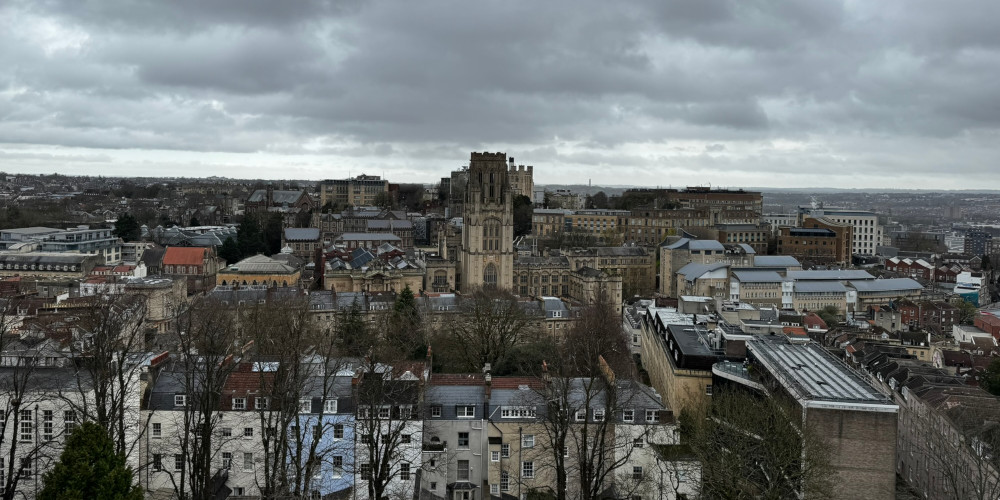
During my first year of my PhD I was working on anomaly detection on natural wooden surfaces. So I presented my work at the ICIT 2024 conference in Bristol, UK. The conference was a great opportunity to share our findings and receive feedback from the computer vision community.